One of the more famous Irish-Americans you’ve never heard of is Jack Donovan Foley. While you may not know his name, you have most definitely heard his work and his legacy. Foley’s name is practically synonymous with sound design in the cinematic world. There is an entire subset of artists whose chosen profession is dedicated to the craft of creating and recording everyday sounds such as footsteps, opening doors, keyboard clicks and so on. These technicians have been known as “Foley Artists” since the early 1930’s.
Jack Foley was born in New York City in 1891 and in 1914 moved with his family to Bishop, California where Jack soon began working as a location scout for silent westerns being filmed around Bishop. He would parlay his connections to Hollywood through scouting into a variety of film industry jobs during the 1920s including working as stuntman and as an assistant to director William Craft.
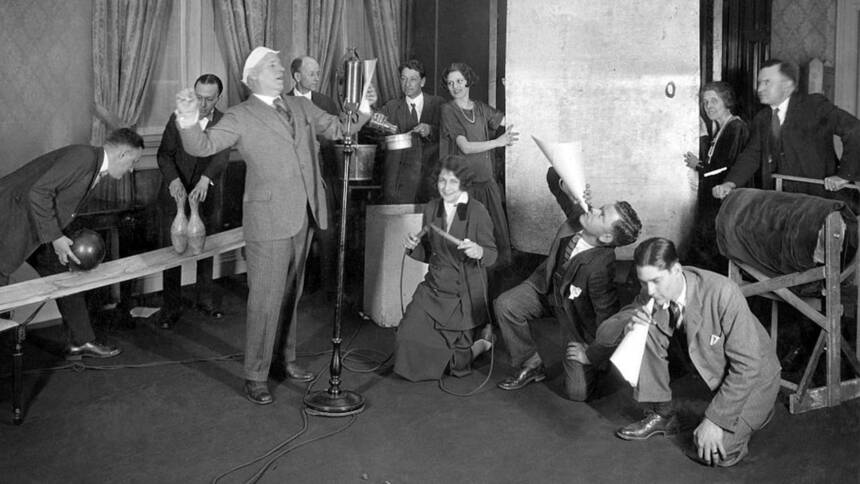
The entire film industry would be turned on its collective head in 1927 when Warner Brothers released The Jazz Singer starring Al Jolson. The film was the first to feature motion picture with synchronized sound from a performer. This technical marvel sent the other Hollywood studios scrambling to release their pictures with synchronized sound as well. At the time, Foley was working on the Universal film Showboat, which had been originally written as a silent musical. That is, it would have been accompanied by live music to a silent picture. To add synchronized sound to Showboat, Universal rented a Fox/Case-Sponable sound-on-film system that interlocked the picture to the audio recording apparatus. They hired a 40-piece orchestra and off to one side, Jack Foley and his crew did hand-clapping, footsteps and added background sounds and voices to the film.
In the immediate years following The Jazz Singer, film editors and executives alike would recognize the importance of creating separate sound effects to enhance the experience of watching motion pictures. With this need and with his Showboat experience, Foley would soon become the go-to technician at Universal for producing these recorded sounds. So much so, he would be given his own small studio that sound would be known as “Foley’s Room” and later “The Jack Foley Stage.” Such was his fame for producing innovative and creative sound effects, that when other facilities began building their sound effect studios, they too were known as “Foley Stages.” Jack Foley would go on to enjoy a nearly 40-year career at Universal as the original Foley Artist, passing away in 1967.
While he was known for this peculiar art, he was not the originator of producing recordable sound effects. Interestingly, the Capital Region had its own practitioner for the radio who pre-dated Foley. Edward Smith of Troy would become one of the world’s first Foley artists when he performed live sound effects during a performance of The Wolf on WGY of Schenectady as part of their initial broadcast on August 3, 1922.
In honor of Jack Foley, here is the recipe for the Irish Cocktail.
2 oz. Jameson Irish Whiskey
2 dashes absinthe
2 dashes curacao
1 dash maraschino liqueur
1 dash Angostura bitters
Mix all ingredients and stir over ice. Strain into a chilled sherry glass. Garnish with an olive.
 Cinema With A Twist