
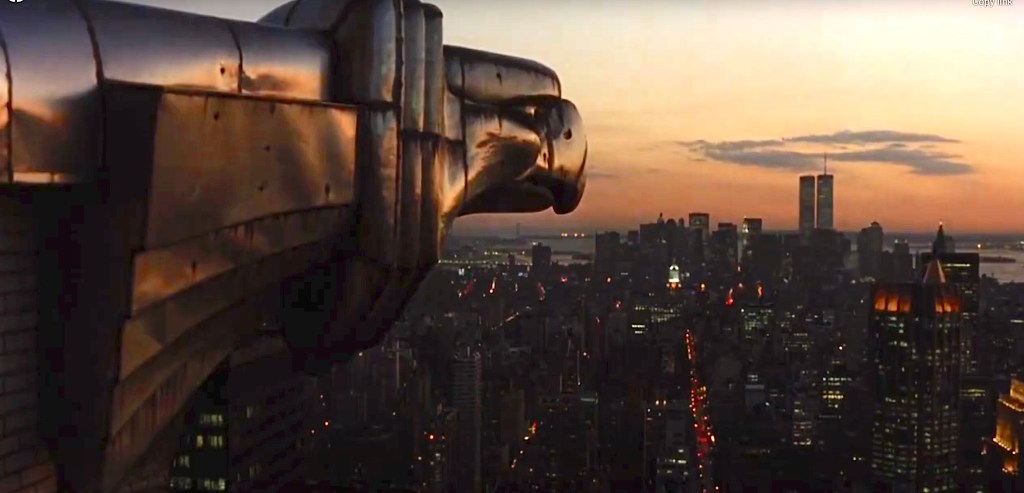
Title sequence of Bonfire of the Vanities, 1990
One of the most common misconceptions about the film & television business is that it is glamorous. It is not. An inordinate amount of time is spent sitting around while you “hurry up and wait.” Fortunately, the business is largely populated by storytellers, many of whom are leagues funnier and better at storytelling than the above-the-line talent that you are working for.
The second show I worked on was the original pilot for John Leguizamo’s House of Buggin’, filmed in January-February of 1994. The location manager for that show was an affable raconteur who I gather has since gone on to become a real estate agent (this tracks). Location managers are the strangest mix of hustlers and diplomats, and this was especially true for those working in the NYC entertainment scene in the 1980s and 1990s. House of Buggin’ was based out of the legendary Kaufman-Astoria Studios in Queens and while the pilot was mostly to be filmed on one of its’ stages, we also shot in various locations around the city. Unsurprisingly, location shoots come with a ton of paperwork and D would often regale us with various stories from past shoots while he was sitting in the production bullpen typing out permit applications.
The most horrific story of these involved an independent movie being shot inside a building on the Lower East Side in the 1980s. Gentrification was still a couple of decades off and this neighborhood was quite rough at the time. Not long after loading the equipment into the building, the lights overwhelmed a circuit and blew a fuse. Part of a location manager’s gig is knowing where the utility boxes are, so D went down into the basement of the building to address the issue. The power and the lights were also out in the basement. He did not have a flashlight handy, but he did have his camera. He made his way through the basement towards the box triggering the flash every couple of steps to briefly light his way. At some point, he stepped on something that wasn’t the floor. He pointed the flash down and fired. He was standing over a very dead body.
Bounding back up the stairs and out onto the street, D flagged down a passing patrolman and explained the situation. The cop waved him off. “I don’t want no part of that paperwork. Call homicide.” The homicide detectives arrived shortly thereafter, kicked the film crew out and cordoned off the building as a crime scene. As the film trucks were being loaded back up out on the street, the film’s producer sidled up to the location manager. “The next time you find a dead body on one of my sets,” he said, “wait until we’ve wrapped until you call the police. That guy wasn’t going anywhere.”
On the other side of the spectrum, D was this location manager who clued me in to the existence of the secretive Cloud Club at the very top of the Chrysler Building. Everybody knows about the Rainbow Room, the famous Art Deco restaurant that opened on the 65th Floor of Rockefeller Center in 1934. Far fewer people, however, are aware about the private Cloud Club that opened four years earlier and occupied the top three floors of the Chrysler Building. Like the rest of the building, The Cloud Club was designed by William Van Alen and it mostly functioned as a swanky power lunch club for the Texaco executives who were the building’s top tenants, as well as New York City’s other captains of industry. It was more than just an elite Deco dining room. It offered a variety of amenities for its members including a stock ticker, a barber, a Tudor-style paneled lounge, a humidor for cigars from around the world, and a wood-paneled bar complete with private locker boxes where members stashed their liquor supplies. Prohibition was still in full effect when the club opened in 1930 and these booze lockers were originally marked with inscrutable hieroglyphics to obscure the identity of the locker’s owner. This magnificent space would eventually close in 1979, just shy of its’ 50th birthday. Throughout the 1980’s, there are a few scattershot attempts to re-boot the club as a nightclub and a discotheque, but none took.
In 1990, Brian De Palma wanted to open his film Bonfire of the Vanities with a time-lapse shot overlooking Manhattan from the top of the Chrysler Building. It fell to D to secure access to the roof which ultimately required direct approval from the building’s owner, Jack Kent Cooke. He would spend a couple of weeks stalking Cooke, spending hours sitting in the waiting room of his office before the owner eventually granted him a brief audience and permission to position a camera next to one of its’ iconic metal gargoyles. The episode allowed D to become well-acquainted with the vacant Cloud Club and, more importantly, build a rapport with the building’s staff. D admitted that he had taken to using the empty Cloud Club as his own secret office in the early 1990s, often lounging in the space with a newspaper or taking calls on a portable telephone.
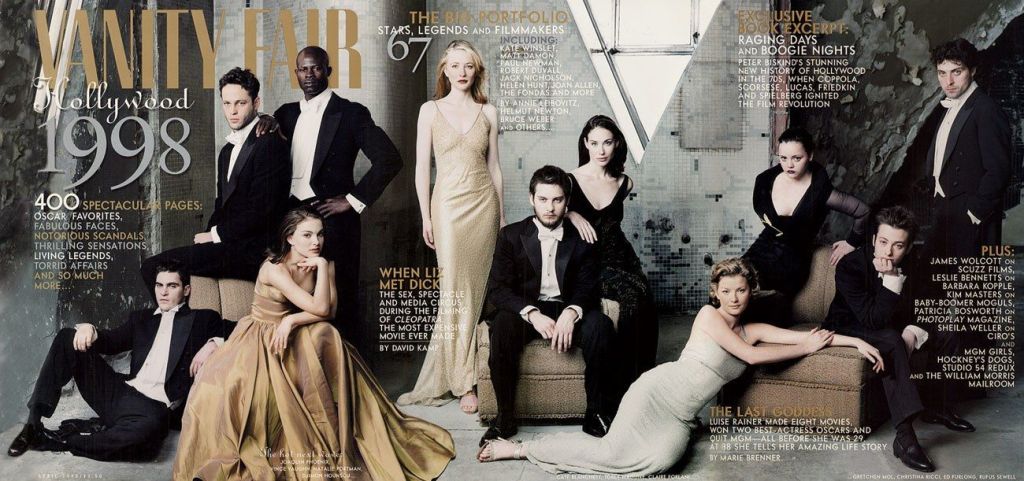
Obviously, this idea of a beautiful, abandoned space at the top of one of the world’s most famous buildings was tantalizing to me, but I was neither crafty nor crazy enough to figure out my own access to the Cloud Club and I mostly forgot about it. Several years passed and I was working on a commercial when I overheard our production designer on the phone prepping for his next job – the annual Vanity Fair Hollywood cover. This shoot is always a Big Deal and in 1998, the featured celebrities including Natalie Portman, Tobey Maguire, Cate Blanchett, Joaquin Phoenix and Vince Vaughn. The location was going to be the Cloud Club. I told L what I knew about the Cloud Club and that I was dying to see it for myself. He is a mensch, and was like, “No problem. Just tell them at the elevator bank you’re part of my art department and go check it out.”
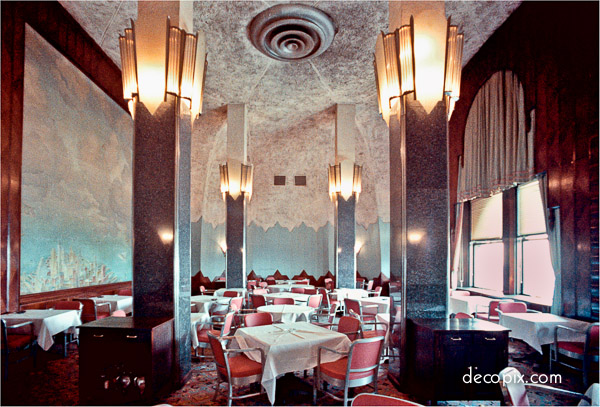
So I did. Given the high-profile nature of this shoot and the building, it was surprising how effortlessly I got in and then wandered around the Cloud Club by myself. (This was pre 9/11 and I was a nobody, which made me practically invisible. To quote Lucas Jackson, “Sometimes nothing is a real cool hand.”) I can honestly say The Cloud Club was one of the most captivating man-made spaces I had ever been in. It had a grand, sweeping staircase in the center and then a number of rooms radiating around the edges of the building. The windows in each room had their own stunning vantage point of Manhattan and the world beyond. Many of the windows were uniquely shaped pieces of glass framed by the tapered metal curves of the Chrysler’s Building’s apex. The Deco mirrors, the murals, the wood of the main rooms were all intact and awaiting a new generation of glitterati to find it.
As I gawked my way through the space and its’ lingering ghosts, it seemed that The Cloud Club was an apt description not just for its’ elevation but also the dream-like sensation of floating it conjured with the constant, unchallenged sunlight and its’ unnatural vacuum of noise. I’ve never flown through the eye of a hurricane, but I imagine it would be similar. Everything was illuminated by the bright haze of the sun as it mixed with the drifting fumes of lowly commerce from the street a thousand feet below. Perhaps it had been noisy once when it was full of hubris and martinis, but it was mostly empty when I experienced it and the noiseless aloofness gave it a rarified quality in the middle of the city. I truly savored the time I got to spend wandering from room to room. Admittedly, it was not hard to see how such a gilded perch at the center of the world’s greatest metropolis could imbue the daily beholder with some unnatural sense of superiority and immortality.
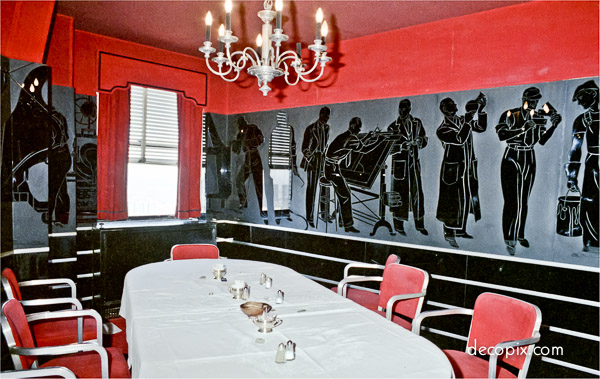
I should note that perhaps my favorite vignette from the Cloud Club did not come from the main rooms, but rather from the bathroom that the New York Times called the “grandest men’s room in all of New York”. The stall closest to the wall in the men’s room featured a triangular window looking out over the western part of Midtown. There was, after all, no need for shyness. I mean, who could possibly see you here? To be able to sit there and do your business with this view must have been truly glorious.
I did not bring a camera on this adventure as I was trying to avoid drawing any attention to myself. Even if I had, no camera I could have brought at the time would have captured the magnificence of the space. I also errantly thought the Vanity Fair crew would be immaculately covering the space with their shoot. They did not. Bizarrely, the main photo for the cover was taken on the top floor of the Cloud Club which had been stripped bare of any opulence or fixtures and was simply being used for storage.
The Cloud Room was gutted just a few years after my visit, though details are scarce. In the early Aughts, the then owners, Tishman Speyer, did their best to keep mum about what was happening with the space in an effort to dodge the ire of the Art Deco Society, going so far as to deny access to a NYT photographer in 2000. A later article reported that it been converted into soulless office space and again was obtuse about where the decor might have ended up. In 2019, numerous glossy magazines noted that interior designer Ken Fulk had been contracted to re-imagine the space as it once was, but little has been reported about that since. The entire Chrysler Building, not just the Cloud Club, has been has been caught in a volatile sea of post-pandemic societal waves that continues to affect commercial real estate both in New York and further afield, resulting in several changes in ownership and management in recent years. A re-boot seems unlikely.
Despite the film industry’s many downsides, one of its’ better perks is that it often allows access to places and people you wouldn’t have otherwise been able to see or meet. I’ve gotten to experience some incredible places over the decades, many of which aren’t accessible to public. The Cloud Club remains at the top of that list and I’m glad I got to see it before it disappeared into the history books.
 Cinema With A Twist