

Have you ever encountered a film and asked yourself ‘how is it possible I’ve never heard of this movie?’ Such was recently the case for me with Allan Moyle’s 1980 film Times Square. I came to it via the film’s extraordinary soundtrack which has a legit claim to be one of the greatest of all time. The double LP features the Who’s Who of pre-MTV alt rock scene happening in NYC at the time including Lou Reed, The Pretenders, The Talking Heads, The Ramones and Patti Smith, just to name a few. On the album cover, just above the masthead of the featured performers is an Warhol-ian inset illustration of Tim Curry as the featured DJ serving up these tasty tracks. Color me curious, indeed.
A short Google gives a little bit of backstory both of its production and its disappearance. The film was produced by Robert Stigwood, i.e. the legendary Aussie music and film producer who gave us The Bee Gees, Grease and Saturday Night Fever. (Unsurprisingly, Robin Gibb also contributes a song to the Times Square soundtrack that is notably different from the gritty underground vibe that propels the rest of the album.) Stigwood was apparently hoping to capitalize on New York’s highly charged renegade rock and punk scene of the late 70’s in a similar way to how he had monetized the city’s disco scene earlier in the decade with Saturday Night Fever. That is, he planned to produce a movie to serve the soundtrack and not the other way around. He hired 33-year old first-time director Allan Moyle to direct a script about two teen girls from polar ends of the social spectrum who escape a dubious mental health treatment program together, live off their wits on the mean streets of Manhattan, create a punk duo (The Sleaze Sisters) and have their rebellious escapades championed over the airwaves by a rogue DJ played by Curry. Sixteen year-old Robin Johnson was cast as sort of a female John Travolta, who does double duty not only as the lead actress but contributes to a number of songs on the soundtrack.
The real trouble with this film seems to have come in the post-production stage. Moyle refused Stigwood’s demands to cut the dialogue scenes in favor of adding more musical sequences to expand the number of tracks for the soundtrack and was subsequently fired. Stigwood finished it his way and the result is a shambolic mess with a janky, disjointed narrative offering little emotional connective tissue. (Moyle would have a similar experience years later with Empire Records, i.e. talented raw young talent, an excellent soundtrack and meddling producers vainly trying to strike teen gold, only to ultimately fail commercially in their pandering attempt.)
As such, Times Square was both a critical and commercial failure. On a budget of $5 million, the film only took in $1.4 million. I’m not sure how well the soundtrack did, but it obviously was an infinitesimal fraction of the 40 million copies of Saturday Night Fever’s soundtrack or the 30 million sold by Stigwood’s Grease. Both the film and the soundtrack effectively vanished from public consciousness. I did a quick straw poll of my fellow Gen-Xers, many savvy in the more esoteric corners of movies & music and not a single person had heard of Times Square. Which, despite the poor editing, is a shame. Beyond the absolutely epic soundtrack, the few dramatic scenes that weren’t completely eviscerated in the Stigwood edit showcase solid acting chops from both Tim Curry and Robin Johnson. Curry being Curry is not a huge surprise – he has always been deliciously good for the entirety of his long and colorful career. But the world might have been better for a film where Robin Johnson was given the space to breakout. After high school, she would only find herself in a few minor roles in the 1980s (including in one of my NYC faves, After Hours) and ultimately became a traffic reporter in Los Angeles.
It is interesting that this film really anticipates the MTV wave that was just about to break across the cultural shores of America and the world, powerfully merging popular music, style and filmmaking into a nearly singular medium. Times Square was released on October 17, 1980, only ten months before MTV planted its first flag on the cable TV moon. I have a feeling that if Times Square had been released two or three years later, many of the filmmaking flaws would have been overlooked and there would have been enough style & music to have at least left a modest imprint on the 80s pop culture scene. To wit, Susan Seidelman’s 1985 film Desperately Seeking Susan paints from much of the same palette as Times Square does a far better job with it. Interestingly, despite Madonna’s participation as a lead and being heavily supported by Madonna’s music video for “Into the Groove” featuring scenes from the film, Desperately Seeking Susan never released a soundtrack for purchase. The budget for Seidelman’s film was the roughly the same as Times Square – $5 million, but Desperately Seeking Susan was a modest hit bringing in $27 million domestically. And people remember it.
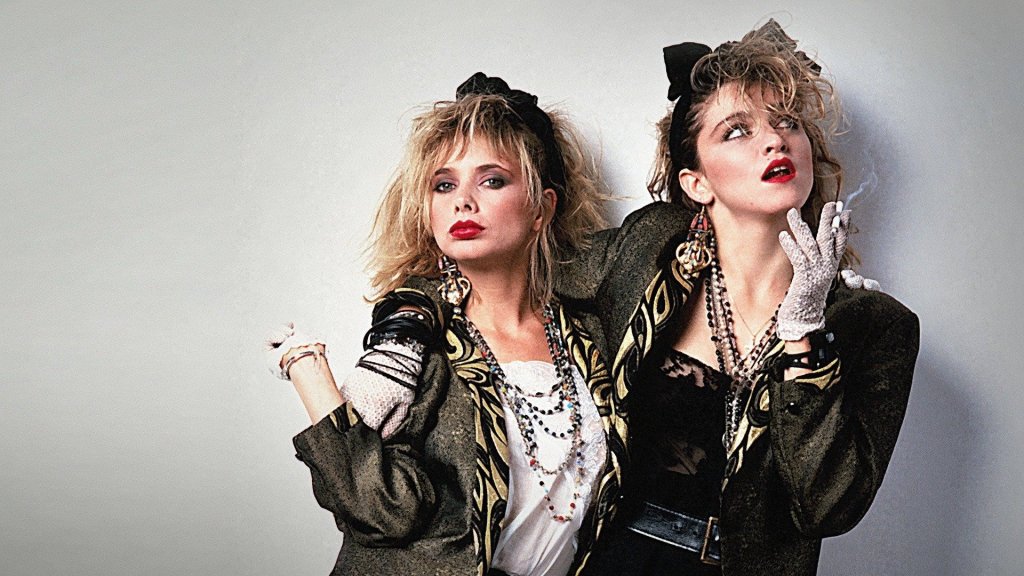
Based on a deeper online investigation, it does seem that Times Square has been quietly gathering a new audience in recent years. I wouldn’t be surprised if this was a knock-on effect from the return of vinyl. I suspect others out there have had the same experience as I have, i.e. stumbling across the soundtrack and becoming instantly intrigued. It does seem to be available for rent across most of the major streamers, but being partial to physical media, I picked up a Blu-ray from Kino Lorber, who must have seen enough interest to commit to the release. I definitely appreciated the vibrant transfer which really captures the color and the spectacle of 1979 Times Square. I haven’t yet listened to the included audio commentary by Allan Moyle and Robin Johnson, but I imagine that like any oral history of that time and place, it is simultaneously dark and hilarious. I’ll try and post an update after I get a chance to listen to it…
 Cinema With A Twist