

With such a discrete and discriminating readership as we enjoy here at ‘Cinema with a Twist’, I have little to fear in sharing two of my favorite secret weapons in the cocktail arts. The first can be had in mere moments and for a trifle. The second requires just a bit more effort and half a trifle.
‘Martin’s New & Improved Index of Cocktails & Mixed Drinks from the First Golden Age of the American Bar’ is an app whose name takes longer to type than it does to download. From his original launch in 2014 to his most recent update in 2022, creator Martin Doudoroff has lovingly compiled a delicious catalog of 2,400 recipes from hundreds of cocktail tomes published ‘between the 1850s to Prohibition’, per his description. (Martin has snuck in a few items that post-date 1933, but I don’t recall seeing a recipe newer than about 1950 in my extensive use of the app.) It is a paid app at $12.99, but I can assure you if you are serious about your cocktail game, it’ll be some of the best money you’ve ever spent. As a bibliophile, I can also tell you many of these antique and vintage volumes can easily run hundreds of dollars apiece for a single original book. I’m going to guess the aggregate value of all of the guides referenced in his index lands easily in the five-figures range, and that’s even before you factor in the thousands of hours he’s spent putting the whole thing together. So give him your 13 bucks.
The app is very user friendly, and allows you to enter the contents of your liquor library which then shows the many options you have on hand or could be possible with the addition of one or two more ingredients. (You can also use it without inputting your stash, as I do.) The resulting entries often contain a great deal of fascinating information on both the ingredients and the recipes.
One of the features that I find truly find amazing is that for many of the more notable cocktails, he also provides a timeline of those recipes so that you can see how the composition of the ingredients has morphed over time. Take the Martini, for example. Doudoroff provides recipes published in 1888, 1891, 1900, 1904, 1906, 1908, 1909, 1922, 1927, 1930 and 1934, thus making it possible to a ‘vertical tasting’ of the Martini’s evolution. (While this is an intriguing idea, I haven’t yet summoned the fortitude to attempt such a thing.)
In some cases, Martin’s dedication is almost too thorough. He does include any number of cocktails that include ingredients that haven’t seen a liquor store shelf in a century. Hercules, a wine-based herbal aperitif which is called for in seven different cocktails, is such an ingredient. It was sold in the 1920s in London by E&F Newall, but doesn’t appear anywhere after the 1930s. While I always find these entries illuminating and interesting, and he usually does offer some form contemporary substitute, I do find it both tantalizing and frustrating when I hit these ingredients in my browsing for a recipe. In any event, Martin’s cocktail app is, without a doubt, the single best ‘cheat code’ for quickly crafting an historic, quality cocktail.
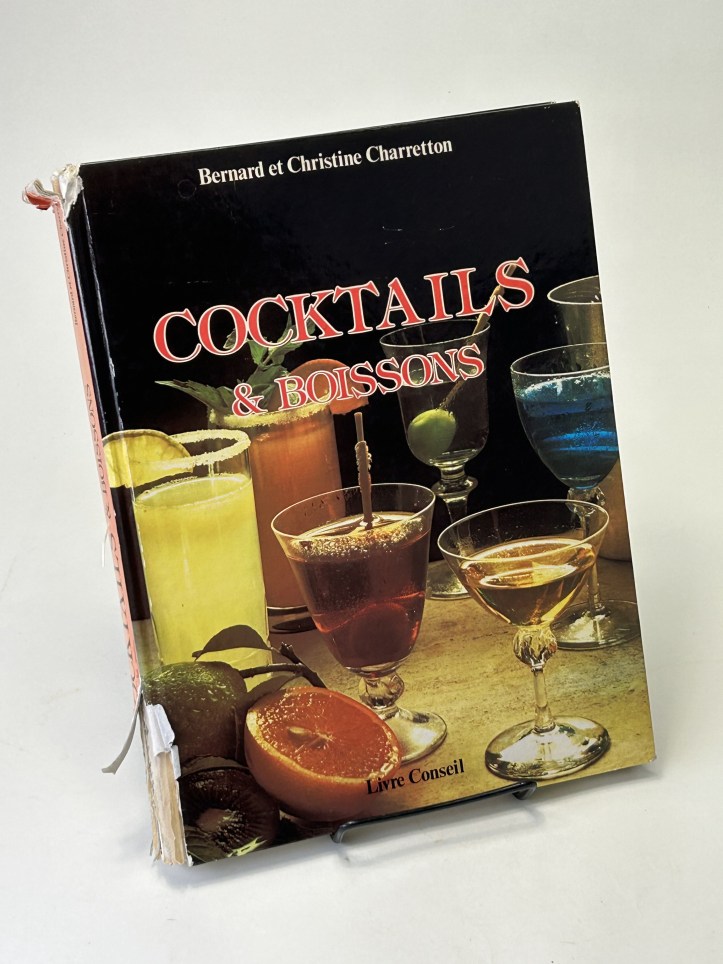
My other secret weapon is a very unassuming French cocktail book published in 1981 by Bernard & Christine Charreton, Cocktails & Boissons. This is the Audi Quattro of cocktail books – a genteel 80s sleeper in the parking lot that once opened up takes the checkered flag the Paris-Dakar Rally year after year. Sourcing it requires a little bit of hunting on Amazon or in used book stores and can be had for about half the price of Martin’s app. I found my copy at the world’s greatest used bookstore, Wonder Book & Video in Frederick, MD, for a whopping $2.95. It should be noted that the book is … in French. I don’t speak French, but I do speak cocktail. Many of the instructions use recognizable ingredients and often repeat the same instructions (Remplissez le shaker de glace! i.e. ‘Fill the shaker with ice’.)
Unsurprisingly, this tome particularly shines when it comes to distinctly French ingredients like cognac, chartreuse, calvados, Cointreau, armagnac, champagne and vermouth. It is also an excellent example of elegance through simplicity. Most of the recipes are fairly straightforward with just a couple of ingredients. (It does also have a little bit of the same frustration factor as Martin’s in that there are some delicious looking cocktails with components like Amer Picon, that are inexplicably not sold in the US.) An excellent example of its offerings is ‘The Widow’ digestif cocktail featuring a heady mix of yellow chartreuse, Benedictine & calvados. Overall, it’s a much smaller catalog than Martin’s, weighing in at about cinq cents (500) recipes, but in the at least 50 cocktails from this book I’ve made, I’ve yet to hit a bad one and I’m consistently amazed at how superb these boissons are.
If you try either of these cocktail resources out, let me know how you fared! I’m always curious to see what types of concoctions speak to people and why.
MUSICAL PAIRING
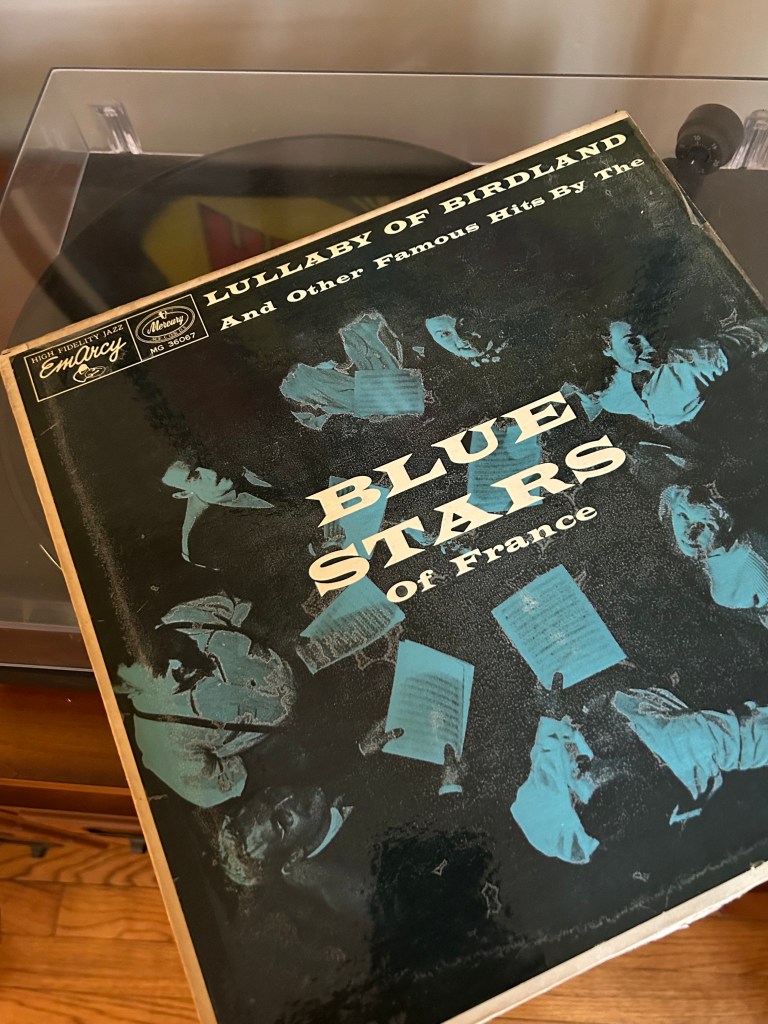
Lullaby of Birdland – Les Blue Stars, 1956
A rather intriguing French-American jazz grouping, featuring vocals by Blossom Dearie– a local gal from right here in East Durham, NY. In addition to their famous French rendition of ‘Lullaby in Birdland’, there is also a French cover of ‘Mister Sandman’, (called here ‘Mister L’Amour’), that I’ve become infatuated with.
 Cinema With A Twist